How to Implement Redundant Servers with Simple HA Software
How to implement active/passive redundant servers with real-time replication and failover?
The SafeKit mirror cluster
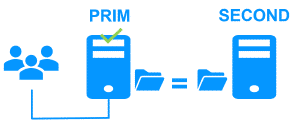
In a mirror cluster, the SafeKit software is installed on two physical or virtual servers running Windows or Linux (on premise or in the Cloud). The primary server is the active server and runs a critical application. The secondary is a passive redundant server receiving in real-time all modifications made by the application inside its files. Clients are connected to a virtual IP address. If the primary server is down, SafeKit restarts automatically the critical application on the passive redundant server which becomes primary and switches the virtual IP address. When the failed server is restarted, it is automatically resynchronized and becomes the passive redundant server running as secondary.
How to implement active/active redundant servers with network load balancing and failover?
The SafeKit farm cluster
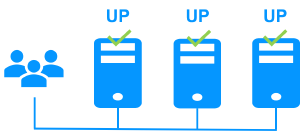
In a farm cluster, the SafeKit software is installed on redundant servers running Windows or Linux (on premise or in the Cloud). All redundant servers are active and run a same critical front-end application. Clients are connected to a virtual IP address. TCP sessions are load balanced between all redundant servers . If one server is down, SafeKit automatically reconfigures load balancing of TCP sessions between the remaining active servers. When the failed server is restarted, it is automatically reintegrated as an active redundant server and receives new TCP sessions.
🔍 Explore SafeKit
Find information about SafeKit features, architectures, videos, documentation, and the free trial.
| Resource | Description | Link |
|---|---|---|
| Key features | Learn why SafeKit is a simple and cost-effective high availability solution. | Discover the key features |
| Use cases | Learn how SafeKit keeps critical applications and infrastructure available. | Explore the use cases |
| Deployment model | SafeKit provides high availability without a SAN or shared storage. | Explore the deployment model |
| High availability strategies | Compare high availability for virtual machines with high availability for applications. | Compare the two strategies |
| Technical specifications | Check the technical requirements and limitations for SafeKit clusters. | Read the technical specifications |
| Videos | Watch demonstrations of SafeKit configuration and automatic failover. | Watch the technical videos |
| Architecture | Learn how the SafeKit Mirror cluster replicates files in real time and handles failover. | Explore the Mirror architecture |
| Architecture | Learn how the SafeKit Farm cluster balances network traffic and handles failover. | Explore the Farm architecture |
| Product comparison | Compare SafeKit with traditional high availability clusters. | Compare the solutions |
| Technical resources | Find technical documentation, download SafeKit, and access the free trial. | Access the documentation and free trial |
| Application modules | Use preconfigured SafeKit modules to set up high availability for your applications. | Explore the application modules |