High Availability and Redundancy for Physical Security Software
SafeKit brings two solutions for redundancy and high availability of a physical security software
Redundancy and high availability at the application level
In this type of solution, only application data are replicated. And only the application is restared in case of failure.
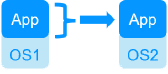
This solution requires a technical understanding of the application. You need to define which services to restart, specify the application folders to replicate, and configure a virtual IP address for failover. But this solution is platform agnostic and works with applications inside physical machines, virtual machines, in the Cloud. Any hypervisor is supported (VMware, Hyper-V…).
Examples
- Video management: 💡 Milestone (Management, SQL, Log, Event)/SafeKit
- Video management: 💡 Genetec (SQL)/SafeKit
- Access control: 💡 Nedap (AEOS, SQL)/SafeKit
- New application (define services to restart, application folders to replicate, a virtual IP address for failover): 💡 Windows, 💡 Linux
Redundancy and high availability at the virtual machine level
In this type of solution, the physical security software is put inside a virtual machine. The full Virtual Machine (VM) is replicated and restarted (Application + OS).
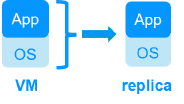
The advantage of this solution is that it does not require a technical understanding of the application; you only need to define the location of the VM files where the application is installed. This solution is generic for any physical security software. However, it works only with Windows/Hyper-V and Linux/KVM, but not with VMware. This is an active/active solution with several virtual machines replicated and restarted between two nodes.
Examples
- Building management: 💡 Siemens Desigo CC/SafeKit
- Video management and access control: 💡 Siemens Siveillance suite/SafeKit
- New application (define the location of the VM files folder where the application is installed): 💡 Windows/Hyper-V, 💡 Linux/KVM
More comparison between VM HA vs Application HA
🔍 Explore SafeKit
Find information about SafeKit features, architectures, videos, documentation, and the free trial.
| Resource | Description | Link |
|---|---|---|
| Key features | Learn why SafeKit is a simple and cost-effective high availability solution. | Discover the key features |
| Use cases | Learn how SafeKit keeps critical applications and infrastructure available. | Explore the use cases |
| Deployment model | SafeKit provides high availability without a SAN or shared storage. | Explore the deployment model |
| High availability strategies | Compare high availability for virtual machines with high availability for applications. | Compare the two strategies |
| Technical specifications | Check the technical requirements and limitations for SafeKit clusters. | Read the technical specifications |
| Videos | Watch demonstrations of SafeKit configuration and automatic failover. | Watch the technical videos |
| Architecture | Learn how the SafeKit Mirror cluster replicates files in real time and handles failover. | Explore the Mirror architecture |
| Architecture | Learn how the SafeKit Farm cluster balances network traffic and handles failover. | Explore the Farm architecture |
| Product comparison | Compare SafeKit with traditional high availability clusters. | Compare the solutions |
| Technical resources | Find technical documentation, download SafeKit, and access the free trial. | Access the documentation and free trial |
| Application modules | Use preconfigured SafeKit modules to set up high availability for your applications. | Explore the application modules |