Eviden Logo

Eviden > Products > SafeKit: All-in-One SANless High Availability & Application Clustering Software > SafeKit: All-in-One Linux Load Balancing & High Availability Software

SafeKit: All-in-One Linux Load Balancing & High Availability Software

The SafeKit Farm Cluster: Software-Only Linux NLB and Automatic Failover

A SafeKit Farm Cluster for Linux is a software-defined Network Load Balancing (NLB) solution designed for scalable application environments. It provides integrated load balancing and failover directly on application servers, eliminating the need for dedicated hardware load balancers, proxy servers, or complex multicast configurations.

What are the advantages of a SafeKit Farm Cluste for Linux?

  • All-in-One Software: Combines Virtual IP, load balancing, and automatic failover/failback in a single software package.
  • No Special Hardware: Replaces expensive hardware load balancers with a pure software solution for Windows or Linux, manageable by sysadmins rather than network engineers.
  • Deep Monitoring & Self-Healing: Uses application-level "checkers" to monitor specific application processes, detecting crashes even if the server is still running; it then triggers an automatic service restart or a failover if necessary.
  • Hybrid Farm & Mirror Capability: Uniquely allows mixing a Farm cluster (for load balancing of front-ends) with a Mirror cluster (for synchronous data replication of back-ends).
  • OEM High Availability: Enables software vendors to embed native clustering into their applications, providing a "cluster-ready" and software-only product without extra infrastructure.
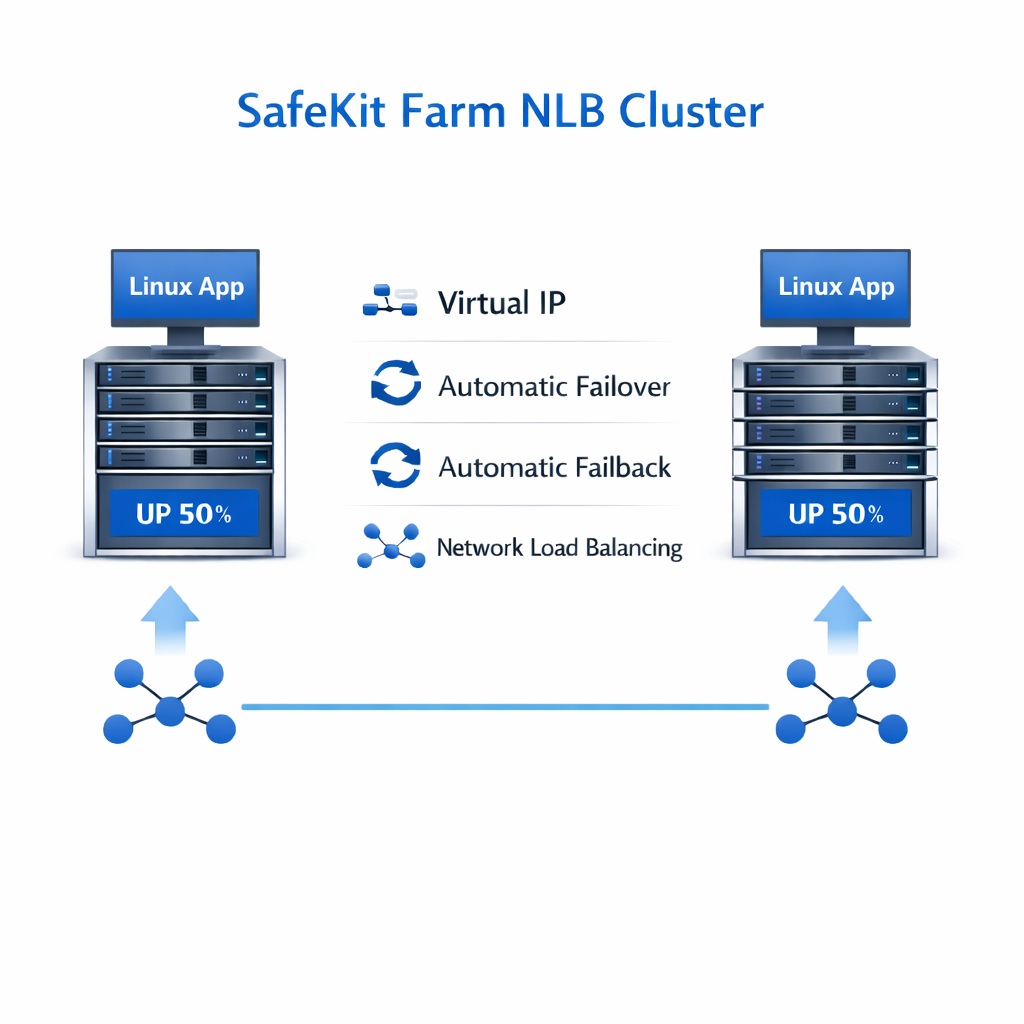
SafeKit High Availability Linux Cluster Architecture providing Virtual IP, Automatic Failover, Automatic Failback, and Network Load Balancing
SafeKit Farm NLB Cluster for Linux

How the SafeKit software simply implements a Linux Network Load Balancing (NLB) cluster?

What is the SafeKit Farm NLB solution for Linux?

SafeKit provides network load balancing and high availability to Linux across two or more servers.

This article explains how to quickly implement a Linux cluster without hardware load balancers or specialized networking skills.

The solution works by defining a virtual IP with load balancing rules, the Linux service names, and health checkers.

SafeKit then enables network load balancing and automatic failover to ensure scalability and continuous service availability.

How does SafeKit simplify load balancing compared to hardware solutions?

SafeKit simplifies management by replacing traditional "middleman" NLB hardware with a pure software solution.

Instead of requiring a dedicated physical appliance, SafeKit runs directly on standard Windows or Linux application servers.

Software vendors can provide OEM High Availability by integrating SafeKit directly into their application stack. This partnership allows vendors to deliver a self-contained, "cluster-ready" and software-only solution that includes native load balancing and failover capabilities.

What are the benefits of SafeKit’s software-based load balancing for Linux?

SafeKit replaces expensive hardware with a streamlined software approach that offers:

  • High Performance: Manages traffic and Virtual IP (VIP) at the OS kernel level, ensuring speed without extra network gear.
  • Operational Simplicity: Allows sysadmins to manage clusters via a unified interface without needing specialized networking certifications.
  • Lower TCO: Reduces CAPEX and maintenance costs by eliminating the need for dedicated hardware load balancers.

How does SafeKit application monitoring differ from standard NLB health checks?

Unlike standard NLB hardware that rely on simple pings and port checks, SafeKit features integrated application-level checkers. While a traditional balancer only confirms if a server is "alive," SafeKit monitors the actual health of specific Linux processes.

This deep monitoring allows the system to detect "zombie" states—where the server is up but the software has crashed—triggering automatic service restarts or traffic redirection that standard NLB solutions cannot perform.

Is it possible to set up a Linux farm cluster without clustering skills?

Yes. This article explains how to quickly implement a Linux farm cluster without the need for specialized and complex networking skills. By using SafeKit’s virtual IP to handle the network load balancing of Linux, you get a robust scalable solution that is significantly simpler to deploy and maintain than traditional NLB solutions.

Beyond Linux, which applications and environments can SafeKit protect?

SafeKit is a versatile high-availability solution for both Windows and Linux. It enables mirror clusters with synchronous real-time replication and automatic failover for a wide range of critical workloads, including:

  • Virtual & Physical Environments: Complete Hyper-V or KVM virtual machines.
  • Container Orchestration: Docker, Podman, and K3s (Kubernetes) environments.
  • Data & Services: Individual file directories, services, and various databases.
  • Cloud Infrastructure: High availability for Cloud applications.

Explore the full list of supported HA solutions here.

How the SafeKit cluster in farm mode works with Linux?

Virtual IP address in a farm-mode cluster

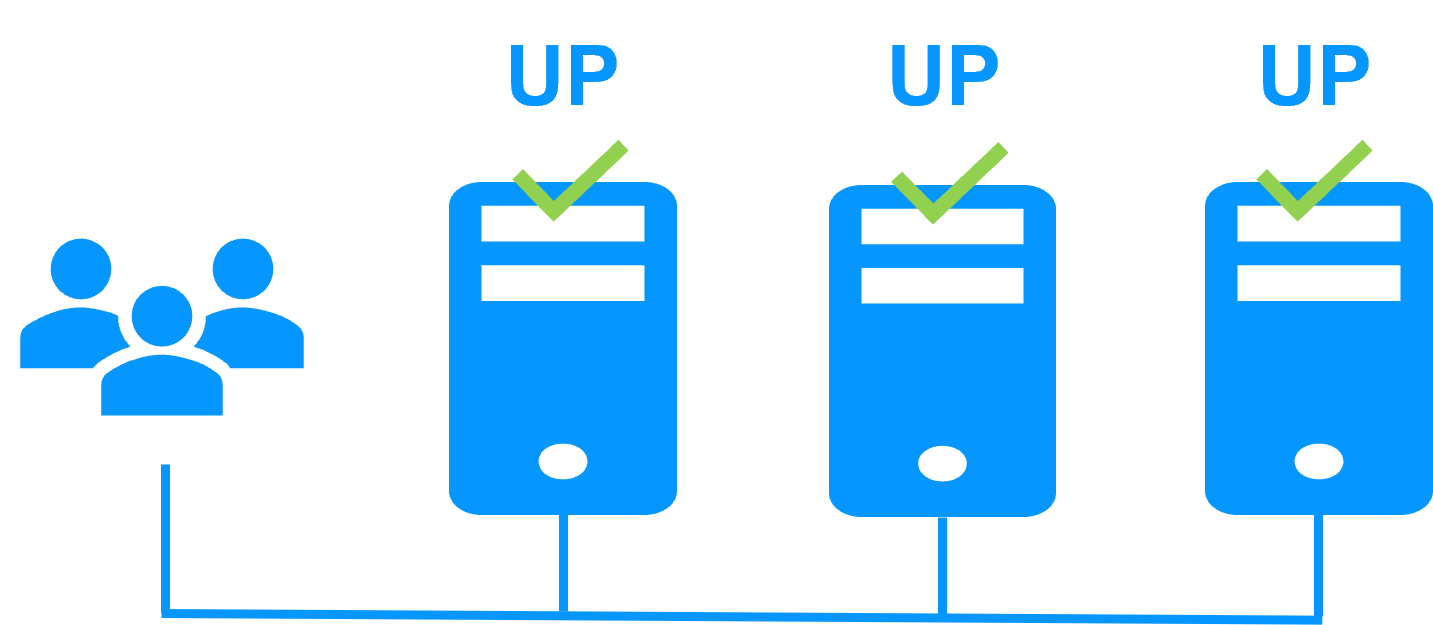
How the SafeKit cluster in farm mode implements Linux network load balancing and failover

On the previous figure, the Linux application is running on the 3 servers (3 is an example, it can be 2 or more). Users are connected to a virtual IP address.

The virtual IP address is configured locally on each server in the farm-mode cluster.
The input traffic to the virtual IP address is received by all the servers and split among them by a network filter inside each server's kernel.

SafeKit detects hardware and software failures, reconfigures network filters in the event of a failure, and offers configurable application checkers and recovery scripts.

Load balancing in a network filter

The network load balancing algorithm inside the network filter is based on the identity of the client packets (client IP address, client TCP port). Depending on the identity of the client packet input, only one filter in a server accepts the packet; the other filters in other servers reject it.

Once a packet is accepted by the filter on a server, only the CPU and memory of this server are used by the Linux application that responds to the request of the client. The output messages are sent directly from the application server to the client.

If a server fails, the farm heartbeat protocol reconfigures the filters in the network load balancing cluster to re-balance the traffic on the remaining available servers.

Stateful or stateless applications

With a stateful Linux application, there is session affinity. The same client must be connected to the same server on multiple TCP sessions to retrieve its context on the server. In this case, the SafeKit load balancing rule is configured on the client IP address. Thus, the same client is always connected to the same server on multiple TCP sessions. And different clients are distributed across different servers in the farm.

With a stateless Linux application, there is no session affinity. The same client can be connected to different servers in the farm on multiple TCP sessions. There is no context stored locally on a server from one session to another. In this case, the SafeKit load balancing rule is configured on the TCP client session identity. This configuration is the one which is the best for distributing sessions between servers, but it requires a TCP service without session affinity.

How to configure a SafeKit cluster in farm mode for Linux?

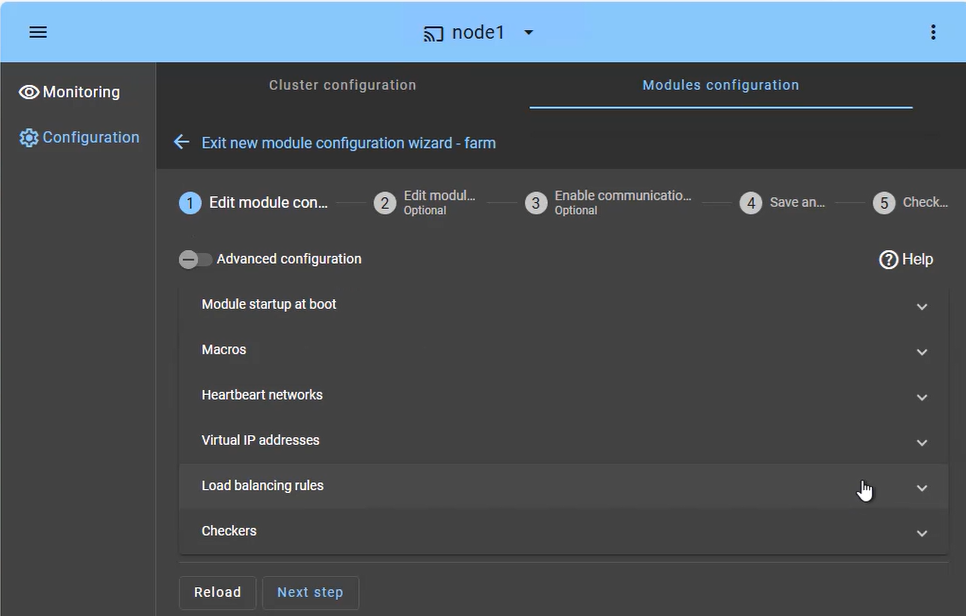
SafeKit Web Console: Farm-mode cluster configuration for Linux network load balancing and virtual IP management.

The SafeKit cluster in farm mode is designed for high availability and scalability of services. The configuration focuses on distributing incoming traffic across both nodes simultaneously:

  • Load Balanced Services (Macros tab): Define the specific application services (e.g., Apache, IIS, Nginx) to be kept active on all nodes.
  • Heartbeat network(s): Communication path(s) used to detect if a node has left the farm, triggering an immediate redistribution of the load.
  • Virtual IP (Farm VIP): Unlike a mirror cluster, the Farm VIP is shared between nodes using kernel filtering algorithm to distribute network traffic.
  • Load Balancing Rules: Define the traffic distribution policy based on the source IP address or port.
  • Checkers: Monitor the application's health and trigger automatic restart if a process failure is detected.

How to monitor a SafeKit cluster in farm mode for Linux?

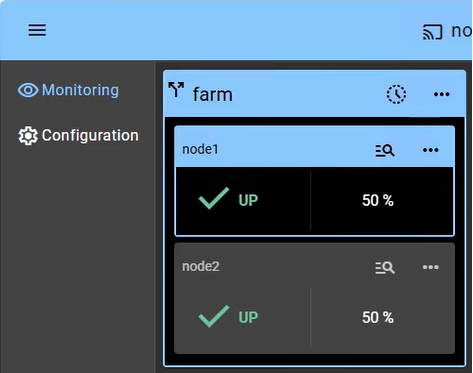
SafeKit Console: Monitoring a 2-node farm-mode cluster showing both Linux nodes in UP state with active load balancing.

Monitoring a cluster in farm mode provides visibility into the Active-Active nature of the infrastructure, where all nodes contribute to the application's performance (showing 2 nodes in this example):

  • UP State (50% on 2 nodes): In a healthy farm, both nodes are in the "UP" (50%) state, meaning they are both actively receiving and processing client requests via the shared Virtual IP.
  • Automatic Re-balancing: If one node fails, the console visually shows the remaining node taking 100% of the traffic. There is no "failover" delay, as the surviving node is already active (aside from a detection time of a few seconds).
  • Node Insertion: When a repaired node is restarted, it transitions from "STOP" to "UP" and automatically starts receiving its portion of the load without administrator intervention.
  • No Data Sync: Note that in a farm-mode cluster, there is no "Orange" resynchronization state, as nodes are expected to be stateless or share a backend database (which can be protected separately in a mirror cluster).

Beyond simple status icons, the interface provides one-click node management, allowing you to manually stop or start a node for planned maintenance while the shared Virtual IP automatically redistributes traffic without interrupting user activity.

Comparison: SafeKit Farm Cluster for Linux vs. Other NLB Clustering Solutions

Feature SafeKit Farm Cluster (Software) Hardware Load Balancers
Architecture Kernel-Level Software: Native integration into Windows/Linux OS. Proprietary Hardware: Dedicated physical appliances.
Management System Admins: Managed via a simple web console; no networking degree required. Network Engineers: Requires specialized skills and CLI certifications.
Health Monitoring Application Checkers: Deep monitoring of specific processes (Apache, Nginx, etc.). Network Ping: Basic check to see if the server or port is reachable.
Self-Healing Built-in Restart Intelligence: Automatically reboots failed services locally. Passive Failover: Simply stops sending traffic to the failed node.
Infrastructure Agnostic: Works on physical, virtual (VMware, Hyper-V), or Cloud instances. Rigid: Requires specific physical cabling and network rack space.
Cost (TCO) Low CAPEX/OPEX: Uses existing server resources; no expensive hardware maintenance. High Investment: High upfront costs plus recurring licensing and power expenses.

Conclusion: A Smarter Approach to Network Load Balancing and High Availability

The SafeKit Farm Cluster represents a strategic evolution from traditional, hardware-heavy networking to a modern, software-defined high availability model. By integrating load balancing and self-healing intelligence directly into the application servers, SafeKit eliminates the cost and complexity of external "middleman" hardware.

Video Guide: Configuring a SafeKit Farm NLB Cluster

SafeKit Video: Network Load Balancing and Virtual IP Management (5:03)

In this video, learn how to implement a virtual IP address to provide a single entry point for a 2-node cluster. SafeKit simplifies network load balancing by automatically managing the virtual IP, ensuring that client traffic is distributed across nodes and redirected instantly during a failover.

Video Highlights

  1. Architecture: Preparing 2 nodes for a shared Virtual IP (0:13)
  2. Configuration: Setting up the farm.safe module and Virtual IP address (2:20)
  3. Validation: Failover testing and Virtual IP redirection on server crash (2:30)

🔍 SafeKit High Availability Navigation Hub

Product Overview

What SafeKit is, mirror/farm architecture, feature comparisons
Document Description Markdown Canonical HTML source
SafeKit Home — part 1 of 3 What is SafeKit, features, use cases, mirror and farm cluster architecture, failover demos html_index_1.md ADD URL
SafeKit Home — part 2 of 3 SafeKit vs. traditional HA clusters, mirror/farm differentiators, SANless vs. Hyper-V/VMware HA html_index_2.md ADD URL
SafeKit Home — part 3 of 3 Free trial, documentation index, application module library html_index_3.md ADD URL
High Availability Software – HA Cluster for Windows & Linux 30-second elevator pitch html_high-availability-software-ha-cluster-windows-linux.md ADD URL
High Availability Architectures Mirror vs. farm architecture patterns html_high-availability-architectures.md ADD URL
Cluster Configuration Overview Configuring a SafeKit cluster with application modules html_cluster-configuration.md ADD URL
Best and Worst Use Cases for SafeKit High Availability SafeKit limitations and where it is not the right fit html_best-worst-use-cases-high-availability.md ADD URL

Competitive Positioning

No SAN required, no Windows Server Datacenter license, no Linux cluster OS expertise (Pacemaker/Corosync/DRBD), no dedicated hardware.

Document Description Markdown Canonical HTML source
High Availability Architectures and Best Practices HA design best practices html_high-availability-architectures-and-best-practices.md ADD URL
Synchronous vs Asynchronous Replication html_synchronous-replication-vs-asynchronous-replication.md ADD URL
Shared Nothing vs Shared Disk Architecture html_shared-nothing-architecture-vs-shared-disk-architecture.md ADD URL
Software Clustering vs Hardware Clustering html_clustering-software-vs-hardware-clustering.md ADD URL
Byte-Level File Replication vs Block-Level Disk Replication html_byte-level-file-replication-vs-block-level-disk-replication.md ADD URL
Alternative to SQL Server Always On (Express/Standard editions) SafeKit as a cost-effective Always On alternative without Datacenter license html_alternative-always-on-sql-server-express-standard-editions.md ADD URL
VM HA vs Application HA Why application-level HA outperforms hypervisor-level HA at the edge html_vm-ha-vs-application-ha.md ADD URL
Microsoft NLB / VMware Multicast-Unicast Alternative html_microsoft-nlb-vmware-multicast-unicast-alternative.md ADD URL

Key Concepts & Educational Content

Document Markdown Canonical HTML source
Data Replication Techniques html_data-replication-techniques.md ADD URL
Heartbeat, Failover, Quorum in Windows/Linux Clusters html_heartbeat-failover-quorum-windows-linux-cluster.md ADD URL
How a Virtual IP Address Works html_how-a-virtual-ip-address-works.md ADD URL
HA Cluster vs Fault-Tolerant System html_high-availability-cluster-vs-fault-tolerant-system.md ADD URL
High Availability DR (HADR) html_high-availability-disaster-recovery-hadr.md ADD URL
What is RPO and RTO? (with examples) html_what-is-rpo-and-rto-with-examples.md ADD URL
SAN vs NAS Shared Storage for Failover Cluster html_san-vs-nas-shared-storage-for-a-failover-cluster.md ADD URL
Power Outage and Network Isolation in a Cluster html_power-outage-and-network-isolation-in-a-cluster.md ADD URL
N-1 Redundancy html_n-1-redundancy.md ADD URL
Active-Active Cluster with Real-Time Replication html_active-active-cluster-real-time-replication.md ADD URL
Network Load Balancing Cluster html_network-load-balancing-cluster.md ADD URL
File Replication with Failover (Mirror Cluster) html_file-replication-byte-level-with-failover-mirror-cluster.md ADD URL
Clustering Software: Load Balancing & Mirroring html_clustering-software-load-balancing-mirroring.md ADD URL
How to Implement Redundant Servers Simply (Windows/Linux) html_how-to-implement-redundant-servers-with-a-simple-software-windows-linux.md ADD URL
SafeKit Web Console (Config, Monitoring, Notifications) html_safekit-smart-console-your-high-availability-cluster-in-your-pocket.md ADD URL

Use Cases

Document Markdown Canonical HTML source
Application Clustering – OEM / Software Publisher html_application-clustering-software.md ADD URL
Business Continuity Software – Distributed Enterprise html_business-continuity-software.md ADD URL
Business Continuity and Disaster Recovery html_business-continuity-and-disaster-recovery-software.md ADD URL
Cluster in Cloud Computing (AWS, Azure, GCP, others) html_cluster-in-cloud-computing-...md ADD URL
Alternative to SQL Server Always On (Express/Standard editions) html_alternative-always-on-sql-server-express-standard-editions.md ADD URL

Edge & OT Solutions

Deployment at the edge: no SAN, no shared storage, no complex cluster OS — remote sites, air-gapped OT networks, embedded appliance-style deployments.

Document Description Markdown Canonical HTML source
Edge HA Without a Data Center: SafeKit for OT & Distributed Sites Definitive edge HA reference — challenge, suitability table, OT constraints, use cases by vertical html_edge-high-availability-...md ADD URL

SCADA & Industrial Automation

Document Markdown Canonical HTML source
SCADA Software Redundancy & High Availability html_scada-software-redundancy-high-availability.md ADD URL
Siemens SIMATIC WinCC Redundancy (Active-Active) html_siemens-simatic-wincc-...md ADD URL
Siemens SIMATIC PCS 7 Redundancy (Active-Active) html_siemens-simatic-pcs-7-...md ADD URL

Physical Security & Video Surveillance

Document Markdown Canonical HTML source
Physical Security Software Redundancy html_physical-security-software-redundancy.md ADD URL
Video Management Software (VMS) Redundancy html_video-management-software-vms-redundancy.md ADD URL
Milestone XProtect Corporate HA html_milestone-xprotect-corporate-...md ADD URL
Milestone Management Migration with SafeKit html_milestone-management-migration-with-safekit.md ADD URL
Genetec + SQL Server HA html_genetec-sql-server-...md ADD URL
Hanwha Wisenet Wave HA html_hanwha-wisenet-wave-...md ADD URL
Hanwha Vision – Cluster Without Shared Storage html_hanwha-vision-cluster-without-shared-storage-on-a-san.md ADD URL
Siemens Siveillance VMS HA html_siemens-siveillance-vms-...md ADD URL
Siemens Siveillance Redundancy (Active-Active) html_siemens-siveillance-redundancy-...md ADD URL
Nedap HA – Replication & Failover html_nedap-high-availability-...md ADD URL

Building Management & Access Control

Document Markdown Canonical HTML source
Building Management System (BMS) Redundancy html_building-management-system-...md ADD URL
Electronic Access Control Software (EACS) Redundancy html_electronic-access-control-...md ADD URL
Bosch BIS HA html_bosch-bis-...md ADD URL
Bosch BVMS HA html_bosch-bvms-...md ADD URL
Bosch AMS HA html_bosch-ams-...md ADD URL
Siemens Desigo CC Redundancy (Active-Active) html_siemens-desigo-cc-...md ADD URL
Siemens SiPass Redundancy html_siemens-sipass-redundancy-...md ADD URL
Siemens SiPort Redundancy html_siemens-siport-redundancy-...md ADD URL

Solutions by OS / Platform

Document Markdown Canonical HTML source
Windows HA – Real-Time Replication & Failover (mirror.safe) html_windows-high-availability-...md ADD URL
Linux HA – Real-Time Replication & Failover (mirror.safe) html_linux-high-availability-...md ADD URL
Windows Load Balancing & Failover (farm.safe) html_windows-load-balancing-failover.md ADD URL
Linux Load Balancing & Failover (farm.safe) html_linux-load-balancing-failover.md ADD URL

Solutions by Database

Document Markdown Canonical HTML source
Microsoft SQL Server HA – Replication & Failover html_sql-server-high-availability-...md ADD URL
PostgreSQL HA – Replication & Failover html_postgresql-high-availability-...md ADD URL
Oracle HA – Replication & Failover html_oracle-high-availability-...md ADD URL
MySQL HA – Replication & Failover html_mysql-high-availability-...md ADD URL
MariaDB HA – Replication & Failover html_mariadb-simplest-...md ADD URL
Firebird HA – Replication & Failover html_firebird-high-availability-...md ADD URL

Solutions by Web Server

Document Markdown Canonical HTML source
Apache Load Balancing & Failover html_apache-load-balancing-failover-2.md ADD URL
Microsoft IIS Load Balancing & Failover html_iis-load-balancing-failover.md ADD URL
NGINX Load Balancing & Failover html_nginx-the-simplest-...md ADD URL

Solutions by Virtualization & Containers

Document Markdown Canonical HTML source
Hyper-V Replication, Automatic Failover & Load Balancing html_hyper-v-replication-...md ADD URL
Linux KVM HA – Replication, Failover & Load Balancing html_linux-kvm-high-availability-...md ADD URL
Docker Container HA – Replication & Failover html_docker-container-...md ADD URL
Podman HA – Simplest Cluster Between Two Redundant Servers html_podman-the-simplest-...md ADD URL
Kubernetes / K3s HA – Replication & Failover html_kubernetes-k3s-...md ADD URL

Solutions by Cloud

Document Markdown Canonical HTML source
AWS HA – Replication & Failover (mirror.safe) html_aws-high-availability-...md ADD URL
AWS Load Balancing & Failover (farm.safe) html_aws-load-balancing-cluster-failover.md ADD URL
Azure HA – Replication & Failover (mirror.safe) html_azure-high-availability-...md ADD URL
Azure Load Balancing & Failover (farm.safe) html_azure-load-balancing-cluster-failover.md ADD URL
GCP HA – Replication & Failover (mirror.safe) html_gcp-high-availability-...md ADD URL
GCP Load Balancing & Failover (farm.safe) html_gcp-load-balancing-cluster-failover.md ADD URL
Generic Cloud HA – Replication & Failover html_cloud-high-availability-...md ADD URL
Generic Cloud Load Balancing & Failover html_cloud-load-balancing-cluster-failover.md ADD URL

Quick Installation Guides

Document Description Markdown Canonical HTML source
All Quick Installation Guides + Module Contents & Download Full module library table, links to each guide, .safe module scripts (.ps1/.sh/.xml) as text html_safekit-quick-installation-guides.md ADD URL
Windows – New App with Replication & Failover ...windows-application-with-real-time-replication.md ADD URL
Linux – New App with Replication & Failover ...linux-application-with-real-time-replication.md ADD URL
Windows – New App with Load Balancing & Failover ...windows-application-with-load-balancing.md ADD URL
Linux – New App with Load Balancing & Failover ...linux-application-with-load-balancing.md ADD URL
SQL Server Quick Start ...with-microsoft-sql-server.md ADD URL
PostgreSQL Quick Start ...with-postgresql.md ADD URL
Oracle Quick Start ...with-oracle.md ADD URL
MySQL Quick Start ...with-mysql.md ADD URL
MariaDB Quick Start ...with-mariadb.md ADD URL
Firebird Quick Start ...with-firebird.md ADD URL
Hyper-V Quick Start ...with-hyper-v.md ADD URL
KVM Quick Start ...with-kvm.md ADD URL
Docker Quick Start ...with-docker.md ADD URL
Podman Quick Start ...with-podman.md ADD URL
Kubernetes / K3s Quick Start ...with-kubernetes.md ADD URL
Milestone XProtect Quick Start ...with-milestone-xprotect.md ADD URL
Nedap Quick Start ...with-nedap.md ADD URL
Apache Quick Start ...network-load-balancing-and-failover.md ADD URL
IIS Quick Start ...with-iis-with-network-load-balancing.md ADD URL
NGINX Quick Start ...with-nginx-with-network-load-balancing.md ADD URL
AWS Mirror Quick Start ...in-aws-mirror-safe-module.md ADD URL
AWS Farm Quick Start ...in-aws-with-network-load-balancing.md ADD URL
Azure Mirror Quick Start ...in-azure-with-real-time-replication.md ADD URL
Azure Farm Quick Start ...in-azure-with-network-load-balancing.md ADD URL
GCP Mirror Quick Start ...in-gcp-with-real-time-replication.md ADD URL
GCP Farm Quick Start ...in-gcp-with-network-load-balancing.md ADD URL
Generic Cloud Mirror Quick Start ...in-cloud-with-real-time-replication.md ADD URL
Generic Cloud Farm Quick Start ...in-cloud-with-network-load-balancing.md ADD URL

Documentation & Training

Document Markdown Canonical HTML source
Online Training html_safekit-on-line-training.md ADD URL
HA Solutions Videos, Demos & Tutorials html_high-availability-solutions-ha-solutions-videos.md ADD URL

Free Trial & Contact

Document Description Markdown Canonical HTML source
Free Trial html_safekit-free-trial.md ADD URL
Free Trial Licence Key html_safekit-free-trial-licence-key-...md ADD URL
One-Month License Key html_high-availability-and-load-balancing-cluster-key.md ADD URL
SafeKit Support Submit and track support requests html_safekit-support.md ADD URL
Get a Quote html_get-a-quote-safekit-en.md ADD URL
Contact Us html_contact-us-for-safekit.md ADD URL

Datasheets & White Papers

Document Description Markdown Canonical source (HTML or PDF)
SafeKit White Paper – English Full technical white paper pdf_wp-safekit-en.md ADD URL
High Availability White Paper html_high-availability-white-paper.md ADD URL
High Availability Guide html_high-availability-guide.md ADD URL
High Availability Overview Datasheet – English pdf_high-availability-overview.md ADD URL
HA Decision White Paper – English Guide to choosing the right HA architecture pdf_wp-hadecision-en.md ADD URL
Nedap AEOS Cluster with SafeKit – Application Note pdf_NEDAP_AEOS_CLUSTER_SAFEKIT.md ADD URL

RFP/RFI & EULA

Document Description Markdown Canonical source
RFP/RFI Technical Reference Technical specifications, limitations, and architecture concepts for procurement teams; includes downloadable DOCX overview html_high-availability-technical-reference-...md ADD URL
EULA – English pdf_eula-en.md ADD URL

SafeKit 8.2 – User Guide (split in Markdown files)

Chapter Covers Markdown Canonical HTML source
Overview and Table of Contents 00-overview-and-toc.md ADD URL
Ch. 1 – Technical Overview Mirror and farm architectures, multi-module, Hyper-V/KVM, cloud overview 01-1-technical-overview.md ADD URL
Ch. 2 – Installation Download, install, license keys, prerequisites, upgrade, uninstall (Windows & Linux) 02-2-installation.md ADD URL
Ch. 3 – Web Console — Configuration Connecting nodes, configuring clusters/modules via wizard and XML editor 03-3-the-safekit-web-console.md ADD URL
Ch. 3 – Web Console — Monitoring Module state monitoring, states timeline, debug snapshots, logs, securing access 04-34-monitor-an-application-module.md ADD URL
Ch. 4 – Tests — Installation, Mirror, Farm Post-install checks; mirror failover/failback/replication tests; farm load-balancing tests 05-4-tests.md ADD URL
Ch. 4 – Tests — Checkers Testing errd, TCP, ping, interface, IP, custom, splitbrain, module checkers 06-44-tests-of-checkers-...md ADD URL
Ch. 5–6 – Mirror and Farm Module Administration State automaton (STOP/WAIT/ALONE/PRIM/SECOND), failover, failback, reintegration 07-5-mirror-module-administration.md ADD URL
Ch. 7 – Troubleshooting — Web Console, Logs, Module States Connection issues, health checks, reading logs, module states, failure scenarios 08-7-troubleshooting.md ADD URL
Ch. 7 – Troubleshooting — Databases, PKI, Email, Antivirus, VIP SQLite size, PKI certs, email agent, antivirus conflicts, VIP/MAC resolution 09-719-problem-with-the-size-of-safekit-databases.md ADD URL
Ch. 8–9 – SafeKit Support and CLI Support procedures; full CLI reference 10-8-safekit-support.md ADD URL
Ch. 10 – Advanced Admin — Environment, Services, Firewall, Security Env vars, firewall ports, boot/shutdown, secure boot, antivirus exclusions, encryption 11-10-advanced-administration-and-setup.md ADD URL
Ch. 10 – Advanced Admin — Web Service, Notifications, SNMP, Logs Web service config, email notifications, SNMP integration, system log 12-109-safekit-web-service-settings.md ADD URL
Ch. 11 – Securing the Web Service — HTTP and HTTPS HTTP/HTTPS setup, certificate management 13-11-securing-the-safekit-web-service.md ADD URL
Ch. 11 – Securing the Web Service — User Authentication Local, LDAP, PKI/certificate-based authentication 14-114-user-authentication-setup.md ADD URL
Ch. 12 – Cluster.xml Configuration Reference Full cluster.xml attribute reference 15-12-clusterxml-...md ADD URL
Ch. 13 – Userconfig.xml — Core, Heartbeat, Farm Topology service, heart, farm, lan elements with full attribute reference 16-13-userconfigxml-...md ADD URL
Ch. 13.6 – Userconfig.xml — Virtual IP Full vip reference: mirror/farm examples, interface and load-balancing attributes 17-136-virtual-ip-address---vip.md ADD URL
Ch. 13.7 – Userconfig.xml — File Replication Full rfs and replicated reference: examples, syntax, attributes, behaviour 18-137-file-replication-...md ADD URL
Ch. 13.8–14 – Userconfig.xml — Scripts, Virtual Hostname, Process Monitoring, Checkers user, errd, proc, check elements; TCP, ping, interface checkers 19-138-module-scripts-...md ADD URL
Ch. 13.15–19 – Userconfig.xml — IP, Custom, Module, Splitbrain, Failover Checkers ip, custom, module, splitbrain, failover elements with full reference 20-1315-ip-checker-...md ADD URL
Ch. 14 – Scripts for Application Module Configuration Lifecycle scripts, variables, execution automaton, SafeKit special commands 21-14-scripts-...md ADD URL
Ch. 15 – Config Examples — Mirror, Farm, Macros, Process Monitoring, TCP Working examples: mirror.safe, farm.safe, hyperv.safe, softerrd.safe, TCP checker 22-15-examples-...md ADD URL
Ch. 15 – Config Examples — Ping, Custom, Splitbrain, Module, Interface, IP, Virtual Hostname Working examples: ping, custom, splitbrain, module (leader/follower), interface, IP, vhost.safe 23-156-ping-checker-example.md ADD URL
Ch. 16–17 – SafeKit in the Cloud and Third-Party Software Mirror and farm clusters in AWS, Azure, GCP; third-party acknowledgements 24-16-safekit-cluster-in-the-cloud.md ADD URL

Release Notes (split in Markdown files)

Part Covers Markdown Canonical HTML source
Part 1 – Overview and Before Starting Supported OS, Linux packages, minor vs. major upgrade types 01_overview_and_before_starting.md ADD URL
Part 2 – Major Changes 8.2: Web Console, Web Service & Logs New PWA console, browser notifications, state timeline, OpenID auth, log levels 02_major_changes_8.2_web_console_service_logs.md ADD URL
Part 3 – Major Changes 8.2: Replication, Checkers & Module Config Replication regex ! prefix, anti-ransomware folder, checker action attribute, splitbrain multi-witness 03_major_changes_8.2_replication_checkers_config.md ADD URL
Part 4 – Major Changes 8.2: Templates, Misc, OpenSSL & Apache Podman template, permanent checker disable, SNMP changes, email agent, OpenSSL table 04_major_changes_8.2_templates_misc_openssl_apache.md ADD URL
Part 5 – Major Changes: SafeKit 7.5.x and 7.4 Changes in 7.5.2, 7.5.1, 7.4.0 (cloud support, SQLite, Kubernetes template) 05_major_changes_7.5.x_and_7.4.md ADD URL
Part 6 – Restrictions and Known Problems Antivirus, replication limits, VIP constraints, known issues by SK ID (SK-0071 to SK-0102) 06_restrictions_and_known_problems.md ADD URL
Part 7 – Migration Instructions Step-by-step upgrade from 7.4/7.5 to 8.2; minor upgrade 7.5.1 to 7.5.2 07_migration_instructions.md ADD URL

SRB & KB

Document Description Markdown Canonical source
SafeKit 8.2 Software Release Bulletin Package builds index, release dates, supported OS/CPU, fixes by build, known issues pdf_82softwarereleasebulletin.md ADD URL
SafeKit 8.2 Knowledge Base SK issue articles indexed by SK ID: symptoms, root cause, workarounds, remediation commands pdf_knowledge-base.md ADD URL

Training Slides

Deck Description Markdown Canonical source
SafeKit Overview VM vs. app cluster, use cases, advantages over WSFC/VMware HA/SQL Always-On (video 9:43) pptx_1-overview-en.md ADD URL
SafeKit Competition Detailed comparison vs. WSFC, VMware HA, SQL Always-On (video 13:21) pptx_2-competition-en.md ADD URL
SafeKit Installation Prerequisites, installation Windows/Linux, cluster node config, upgrade (video 14:26) pptx_3-install-setup-en.md ADD URL
SafeKit Web Console Cluster/module config, monitoring, maintenance, securing the console (video 34:02) pptx_4-web-console-en.md ADD URL
SafeKit CLI Cluster/module config, start/stop, monitoring from command line (video 15:52) pptx_5-command-line-en.md ADD URL
SafeKit Mirror Module userconfig.xml, heartbeats, VIP, rfs, start_prim/stop_prim, state transitions (video 26:52) pptx_6-mirror-module-en.md ADD URL
SafeKit Farm Module userconfig.xml, farm heartbeats, VIP/load balancing, start_both/stop_both (video 16:16) pptx_7-farm-module-en.md ADD URL
SafeKit Checkers Process/service monitoring, interface/VIP checkers, custom, split-brain, TCP/ping/module (video 20:34) pptx_8-checkers-en.md ADD URL
SafeKit Troubleshooting Log analysis, module snapshots, web console/CLI/mirror/farm/checker issues (video 31:24) pptx_9-troubleshooting-en.md ADD URL