FAQ: Optimizing RPO and RTO for Business Continuity
Can RPO and RTO be zero?
Yes. Achieving a zero RPO means no data loss, which is possible through synchronous data mirroring. A near-zero RTO is achieved through automated failover software like SafeKit, which detects failures and restarts applications on a secondary node within seconds or minutes.
Which is more important: RPO or RTO?
Neither is inherently more important; they serve different roles. RPO (Recovery Point Objective) focuses on data loss—how much data you can afford to lose. RTO (Recovery Time Objective) focuses on downtime—how quickly you must be back online. For mission-critical applications, both must be minimized.
What is the difference in RPO and RTO between SafeKit at the application level vs. VM level?
While both ensure an RPO of 0 via synchronous replication, they differ in recovery time:
- Application Level: Faster RTO (approx. 1 min) because only application services restart on an already running OS. It also detects specific software/process crashes.
- VM Level: Higher RTO because the entire Virtual Machine must reboot on the secondary host. While application-agnostic, it lacks granular monitoring of the application processes themselves.
What is the difference between HA and backup solutions in terms of RTO?
High Availability (HA) typically offers a much lower RTO (seconds to minutes) because it handles local failures automatically. Disaster Recovery with backup solutions (DR) usually has a higher RTO (hours to days) because it involves recovering data and services at a geographically distant site after a major catastrophe.
How do I achieve the best RPO and RTO between remote sites?
Achieving a zero RPO and near-zero RTO across remote sites requires a combination of synchronous replication and an Extended LAN (Stretched VLAN):
- Extended LAN / Stretched VLAN: By stretching the same subnet (Layer 2) across two data centers, you can move an application from Site A to Site B without changing its IP address, avoiding complex DNS updates.
- The SafeKit Solution: SafeKit leverages this by providing a software-defined Virtual IP (VIP) that floats between sites. It instantly reroutes traffic to the secondary site using Gratuitous ARP (GARP).
This delivers an RPO = 0 (real-time mirroring) and a minimal RTO (failover in approx. 1 minute) without human intervention.
Why is combining High Availability and Backup essential for optimizing RPO and RTO?
Combining High Availability (HA) with a backup solution is the only way to achieve a "best-of-both-worlds" recovery strategy. While they are often discussed together, they solve different parts of the RPO/RTO equation:
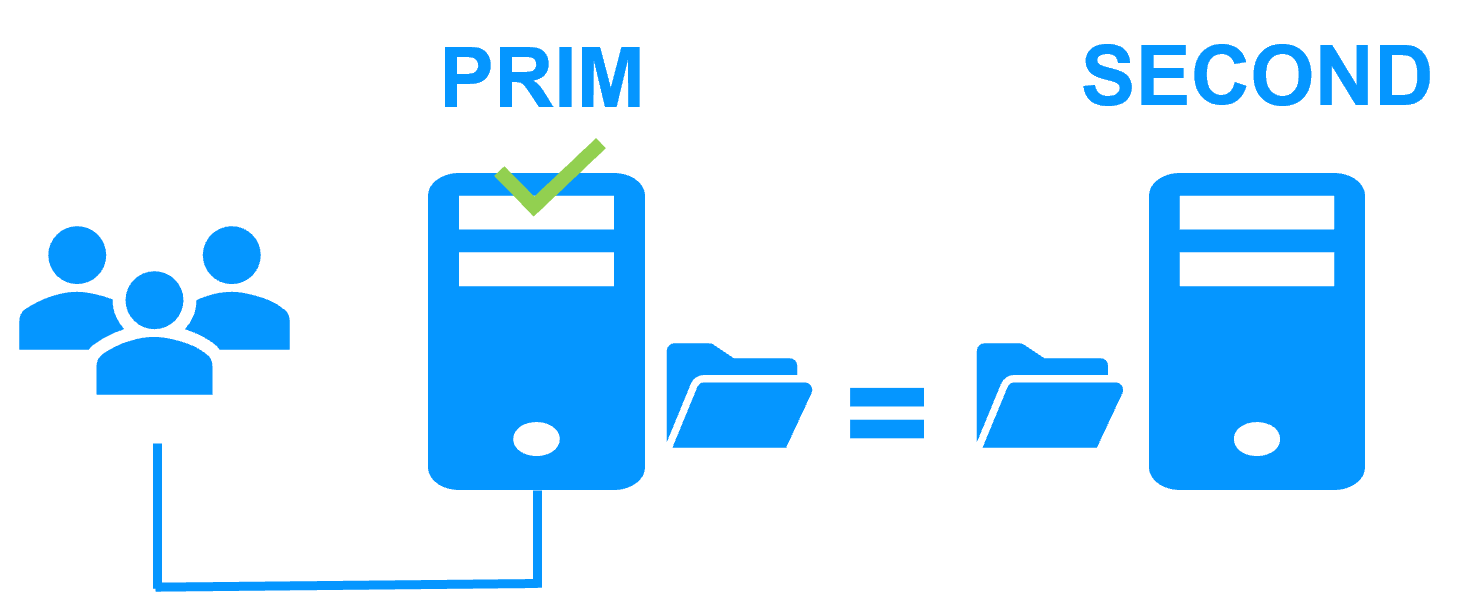
- High Availability (via SafeKit): Optimizes for near-zero RTO and zero RPO during hardware or software failures. By using real-time synchronous replication, the secondary server is always up-to-date. If the primary fails, the service restarts on the secondary immediately with no data loss.
- Backup Solutions: Protect against data integrity issues (like ransomware or accidental deletion). Because HA replicates changes instantly, it will "faithfully" replicate a virus or a deleted database record to the standby server. A backup allows you to "go back in time" to a point before the corruption occurred.
- The Hybrid Approach: For maximum resilience, organizations use a 3-node hybrid architecture. This includes a 2-node local cluster with synchronous replication for immediate HA, and a third remote copy (asynchronous) for Disaster Recovery. This layered defense ensures that you have a "live" copy for instant recovery and a "historical" copy for data safety.